Product Updates
Automating the monthly close for lease accounting
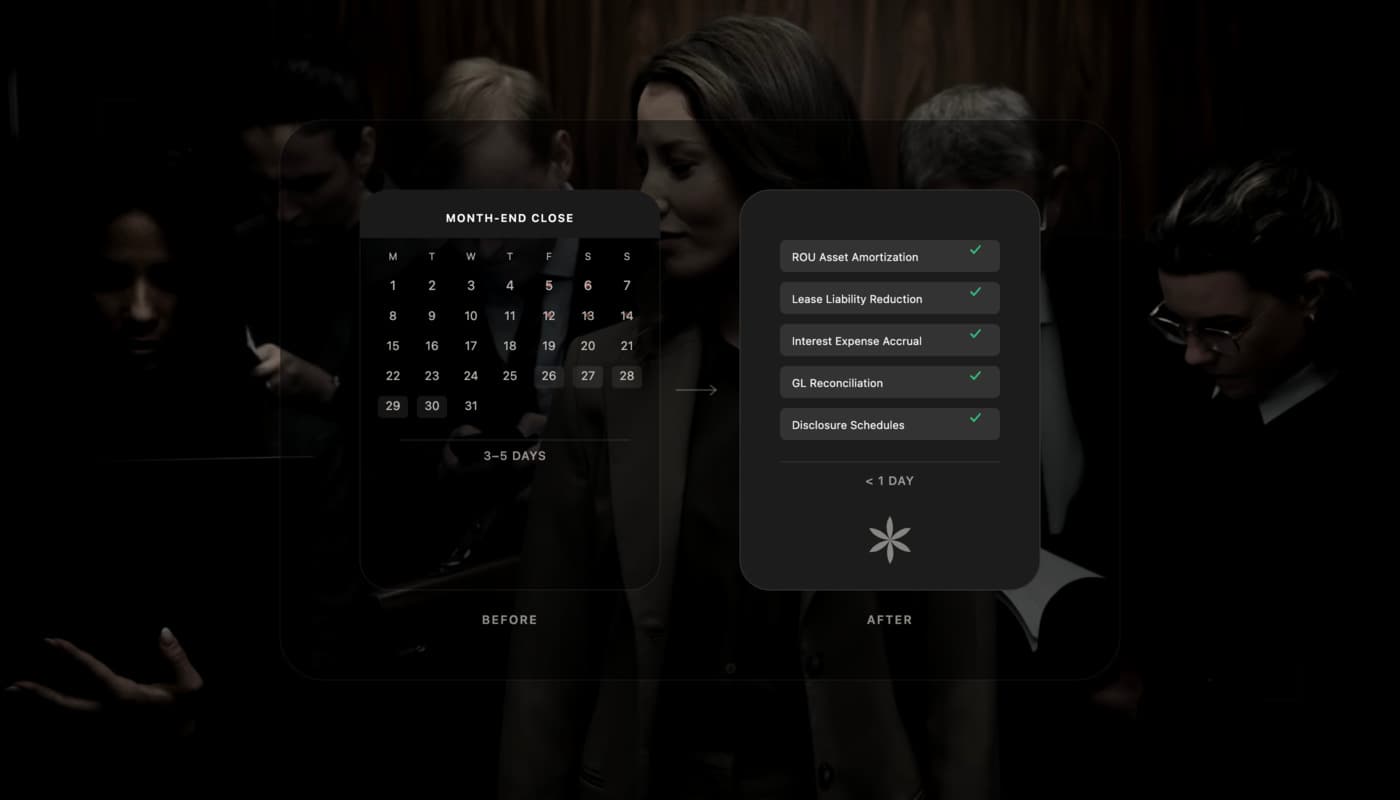
Controllers are closing the books faster than ever. Here is how AI-powered lease accounting fits into the modern close process - and why the old way is unsustainable.
Automating the monthly lease close reduces the process from three to five days down to a single day or less. The time savings come from eliminating manual schedule recalculation, journal entry formatting, sub-ledger reconciliation, and disclosure assembly - the four steps that consume the most effort in every close cycle. This is one piece of the broader challenge of reducing close cycle time across the entire finance function.
Every month, the same cycle repeats. Recalculate amortization schedules. Generate journal entries. Reconcile the sub-ledger to the GL. Update disclosure templates. For organizations with hundreds or thousands of leases under ASC 842, this workload can consume three to five days of every close cycle.
That is three to five days the team does not have. For a complete month-end close checklist, including the non-lease steps that often run in parallel, see our 2026 guide.
Automation does not mean removing the accountant from the process. It means eliminating the repetitive mechanical work so skilled professionals can focus on review, analysis, and the judgment calls that actually require their expertise.
Where time disappears in the lease close
Before looking at solutions, it helps to understand exactly where time goes during a typical close. Most teams report that the bulk of effort falls into four areas:
- Recalculating schedules. Every lease modification, payment change, or index adjustment requires updated amortization schedules. Doing this manually in spreadsheets is error-prone and slow.
- Generating journal entries. Once schedules are updated, entries must be created in the correct format for the general ledger - mapping lease accounts to GL accounts, applying entity-specific coding, handling currency conversions.
- Reconciling balances. Right-of-use asset and lease liability balances on the sub-ledger must tie to the general ledger. Discrepancies require investigation and correction before the books can close.
- Preparing disclosures. Quantitative and qualitative disclosure schedules must be updated with current-period data, often requiring manual aggregation across entities and lease types.
Each step involves transferring data between systems. Every transfer introduces latency and transcription risk. The more leases in the portfolio, the more these inefficiencies multiply.
Manual Lease Close
- ×3-5 days every close cycle
- ×Spreadsheet schedule recalculation on every modification
- ×Copy-paste journal entries into ERP format
- ×Manual sub-ledger to GL reconciliation
Automated Lease Close
- ✓Single day or less per close cycle
- ✓Event-driven recalculation as lease events occur
- ✓One-click journal entry generation with direct ERP export
- ✓Real-time reconciliation with variance flagging
What an automated close looks like
An automated lease close collapses these four steps into a single workflow.
The platform continuously maintains up-to-date amortization schedules as lease events occur throughout the month. When the close period arrives, journal entries are generated automatically in the format your ERP expects - complete with entity codes, account mappings, and supporting detail. No reformatting. No copy-paste. No reconciliation spreadsheets.
The capabilities that drive this:
- Event-driven recalculation. Schedules update when lease events occur, not when someone remembers to refresh them.
- One-click journal entry generation with direct ERP export or API push.
- Real-time reconciliation between the sub-ledger and GL, with variance flagging that catches issues before they become findings.
- Pre-built disclosure templates that pull from live data, eliminating manual aggregation.
Teams using automated close workflows consistently report reducing their lease close from three to five days down to a single day or less. The improvement comes not from working faster, but from eliminating the manual data movement that consumed most of the effort.
3-5 days
Typical manual lease close duration
< 1 day
Automated lease close duration
4 steps
Eliminated: recalculation, journal entries, reconciliation, disclosures
Building confidence in the numbers
The most common concern controllers raise about automation is trust. If no one manually calculated the numbers, how do you know they are right?
The answer is transparency.
A well-designed platform provides a complete audit trail for every calculation - the inputs, the formulas, the standard references behind each journal entry. Auditors can trace any balance back to its source lease agreement and verify the logic independently.
This level of traceability actually exceeds what most spreadsheet-based processes provide. In a spreadsheet, the audit trail is a set of formulas that someone built months ago and no one has documented since. In a purpose-built platform, every calculation is reproducible, every change is logged, and every output links back to its source. That is not just automation. That is a better control environment.
Lease close is one piece of the broader month-end close challenge. When lease journals feed directly into Financial Close workflows, alongside account reconciliation, consolidation, and entity certification, the entire close compresses, not just the lease portion. Teams pursuing a continuous close model can run lease reconciliation throughout the month, so the close window focuses on final validation. See how Arvexi Lease Accounting automates the close, or read our ASC 842 implementation guide for a deeper dive.
Related reading
- Financial Close Automation: How AI is Shortening the Close Cycle
- What is Financial Close?
- Best Financial Close Software for 2026
- Close Tasks - AI-powered scheduling and dependency tracking
Stay in the loop
Subscribe to our newsletter to receive the latest from Arvexi.
More stories

